Wednesday, September 23, 2009

Night Boat to Barcelona

night boat to BarcelonaChapter 33

As Helen's wedding preparations were under way, it became necessary for her to make a trip to Barcelona in order to finalize the guest list and other details of this important event with José and his family who lived near Barcelona's city centre in a residential apartment or piso.

Since it wasn't considered proper for Helen to travel alone she was to have a chaperone. I was elected. And of course I was delighted to be offered a paid trip to Barcelona when my only task would be to accompany Helen and her fiancé around the city and visit his parents.

We would travel on the overnight ferry of the Trasmediterránea Line from Palma and stay in a hotel.

logo Trasmediterranea
As I didn't have a small overnight bag, I prepared my pink and green striped plastic suitcase that had served for my trip from Vancouver to Spain. Not much to put in there except the black and white flowered cotton dress I'd made before leaving Canada, one pair of shoes, nightdress, housecoat and slippers.

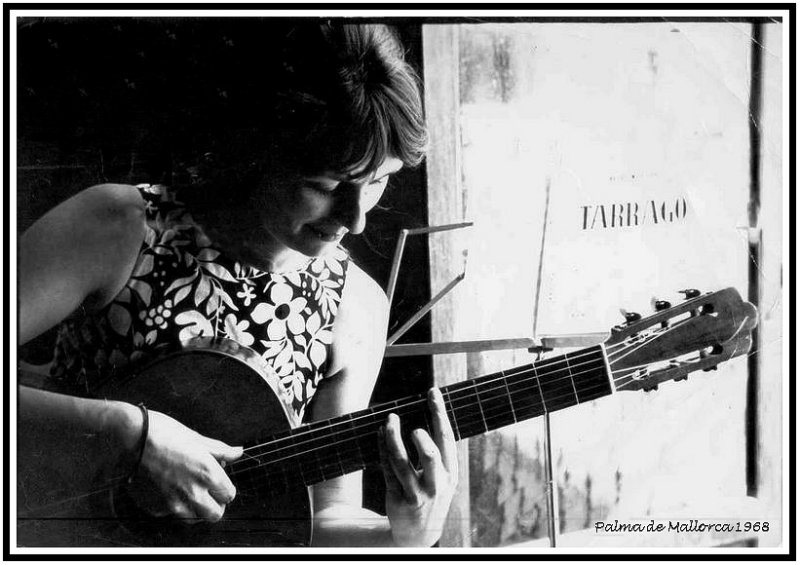
I made sure to bring my camera, an old German Voigtländer 35mm film camera that my father had given me on my 21st birthday. As I didn't have enough money to pay for colour film, I used black and white or slide film for which, in later years, I was thankful, since the photo quality lasted fairly well over the years, certainly better than could be expected of coloured prints of that time.

We also brought what was the standard snack food to take on picnics or journeys: the famous Inca biscuits of Mallorca. No picnic or venture away from home could be undertaken without a bag of these galletas de Inca which were first elaborated in the 19th century at the request of shipping companies which needed a sturdy biscuit suitable for taking on long voyages. The name comes from the original factory in the town of Inca, Mallorca.

Inca biscuits
Hard, oval, thick crackers, with a slight centre indentation, packaged in a transparent plastic bag and which, when squeezed a certain way on the sides with both hands would split perfectly in half horizontally, making them easy to top with a drop of olive oil, a small piece of cheese or ham. When you pressed too hard, or the wrong way they would crumble and you'd have to eat the little dry pieces from your lap.

Another indispensable snack for travelling was a bag of Galletas Maria.

Galletas Maria
Thin, flat and round, these were slightly sweet biscuits which would hardly have been popular in Canada I thought, as they were so plain. However in Spain at that time when there was little else available, one became accustomed to them, even learning to enjoy dipping them in coffee for breakfast.
flag of trasmedThe boat was to leave the Palma dock late at night and would arrive early the next morning in Barcelona. The sleeping accomodation at that time was in segregated (women or men only) windowless four-berth cabins, consisting of two sets of bunk beds with a wash basin in between and a bathroom down the corridor. This photo from www.norwayheritage.com shows a cabin similar to ours on a different ship, except that we were in a four-berth room with no window. But ours was as basic as the one in this photo.

two berth cabinAs we didn’t as yet have cabin companions, we left our cases in the room, closed the door and went up on deck to the bow of the ship. There was a full moon and the air was warm. As we stood in the evening breeze in our summer dresses, the boat began to move away from the dock and I marvelled at the mild Mediterranean air. Even as the ship picked up speed, the breeze was balmy.

I recalled such evening boat trips from Vancouver to Vancouver Island, where out on deck on an early summer evening we would be warmly wrapped in pullovers or jackets. When the lights of Palma harbour were far in the distance we went back downstairs to our cabin. We had company.

Gypsy MotherGypsy Mother - Painting by Robert Henri 1906

There was a middle aged Spanish lady arranging her belongings in the opposite top berth and a young gypsy mother with a baby sitting on the bottom berth.
The young mother looked like a child herself. Her baby was cranky and whining and I wondered if they had eaten that day. After we exchanged greetings, Helen and I prepared for bed. I took the upper bunk.
As there were no lockers in the room, we had to sleep with our suitcases and handbags at the end of the berth, by our feet. I wondered if I would get any rest that night, since I was so excited over this venture. But the motion of the boat soon put me into a sound sleep.

Unfortunately the gypsy mother was seasick and spent the night vomiting into the washbasin. We weren’t aware of it until early morning when we woke and discovered her plight. The baby was crying out ‘pa…pa…pa’ which I couldn’t understand but was told by Helen that he was saying ‘pan’ - bread.

The child was hungry and they didn’t have anything to eat. So we gave them the Galletas Maria which would have to do until they reunited with the male members of their family who were sleeping in another part of the ship.

After Helen and I had each taken a breakfast of cafe con leche and a hard breakfast bocadillo (small baguette sandwich) with cheese in the cafeteria we went out on deck to watch the arrival in Barcelona as the sun was rising.
It was a beautiful beginning to our day.

Photo credit Barcelona Sunrise to Louise Huot on Webshots

escudo trasned
Next: Gaudi and the Gothic Quarter
Go back to Chapter 32 The Bride's Hand

Tuesday, September 15, 2009

The Bride's Hand

The Marriage Proposal The Marriage Proposal
Frederic Soulacroix 1858 - 1933

Chapter 32

In Spain it is customary for the families of a future bride and groom ...los novios...to meet for a friendly luncheon, tea or dinner in the prenuptial event called "the asking of the hand"...la petición de mano.

Whereas in former days the groom may have made a formal request to the bride's father for her hand in marriage, the custom was gradually disappearing. The bride and groom had by this time decided to marry and the petición de mano became more of an engagement party where the two families would have the opportunity to meet, perhaps for the first time.

At this time the engagement ring is presented to the bride by her future husband, while she customarily presents him with a watch or engraved cuff links.

Since Helen's future inlaws lived in Barcelona, they took a hotel room in Palma for their short visit to the island. Helen and her father would be hosting the casual coffee afternoon in the apartment in which I was a guest. Vases were filled with flowers. Coffee and light refreshments were prepared.

Finally the three arrived...the handsome groom, José, dressed in a dark suit, his mother, dressed in black and his father also dressed in a dark suit. It was customary at that time for Spanish women to wear black for most important occasions, whether or not they were in mourning (de luto) for a deceased family member, which under Catholic Church customs kept them wearing black for most of their senior years.

However on this occasion the dark clothing was for the significance of the event. Mr. G. also wore a dark suit and tie, while Helen and I wore printed summer dresses. I was not long in Spain, having recently arrived from Canada, so I found all this to be most unusual and interesting.

After the coffee, the pleasantries and exchange of gifts, we all went out for dinner to a lovely restaurant. Here in this photo below, you see from left to right, the groom's parents, Helen (pseudonym) the bride, José the groom, and George Bowden...Mr. G.

peticion de mano family

Here below are some more transparency photos I made in El Pueblo Español, the Spanish Village, located in Palma de Mallorca during this time, shortly after my arrival in 1968.

La Guitarreria - the entrance to Mr. G's guitar factory:
La Guitarreria The Basket Maker:
the basket maker In Pueblo Español:
pueblo español Reproduction of La Alhambra:
la alhambra Vancouver Chuck with José Ferrer - guitar maker:
Chuck with José Ferrer Pueblo Español:
Pueblo Español
Continue on to Chapter 33 Night Boat to Barcelona
Go back to Chapter 31 Living in Palma

Wednesday, September 9, 2009

Living in Palma

kitchenBack from Santa Catalina Market in Palma

Chapter 31
(click to enlarge photos)

In the late 1960s I was staying in Palma de Mallorca at the apartment of Mr. G and his daughter Helen (not her real name) until I could establish myself in my new job teaching music and find my own accommodation. Helen and I shopped weekly at the Santa Catalina market where we bought the vegetable and meat supplies for the next days. All was carried in one or two mesh shopping bags or my big straw basket which we took with us.

I was happy to find this above photo, taken as a slide with my old film camera. It shows part of the apartment's tiny kitchen. Here is another one:

palma kitchen The water heater was suspended from the ceiling, the double sink was low and small and there was little counter space. What you see in both photos is the total work space for preparing meals.

Downtown we would walk along the Paseo del Borne and around to the Via Roma, which I believe has since been renamed. This was the avenue of the flower sellers where the central paved boulevard housed the many stalls where flowers were sold. When one wanted to buy a bouquet for a special occasion or just a few flowers for the house, the Via Roma was the place to go.

flower stalls 1

flower stalls 2
On our Sunday outings in the Citroen deux chevaux we would often drive to the picturesque terraced slopes of Banyalbufar on Mallorca's west coast:

banyalbufar 1


As Helen was engaged to be married to her Spanish novio, her fiancé José, she was preparing her trousseau as was customary with young women then. She was concerned that her future mother-in-law might feel that since her son was going to marry an estranjera (a foreigner) rather than a Spanish girl, she might not have the premarriage custom of hand embroidering their linen, such as bed sheets and pillow cases with the initials of the couple.

Since young women then spent hours sewing linens in preparation for a future marriage, Helen wanted to make sure that she did her part by embroidering and adding lace edging to sheets and pillowcases. I remember being so amazed at this detail that I asked Helen's permission to lay out some of her work for a photograph, which now unfortunately seems to have deteriorated more than some of the other photos.

embroidered sheets
Two big events were coming up. The petición de mano, or the asking of the hand by the novio José, and the trip to Barcelona, where I was to go with Helen as her chaperone, or carabina.

The asking of the hand is often the first time that the future in-laws meet. The occasion is a friendly reunion of the two families, where in fact the future husband does not actually have to make a formal request to the bride's father for her hand. Rather they meet for a luncheon or afternoon tea, the engaged couple exchanges gifts, usually the engagement ring for her and a watch, cufflinks or other sentimental piece of jewellery for him. Photos are taken and some wedding plans may at that time be discussed. The groom's parents would be travelling to Palma for this event.

And the trip to Barcelona was going to be an exciting time. Helen and I would go by overnight boat to Barcelona where we would meet again with his family to finalize wedding plans, see the city and stay in a hotel, all the time while I was to chaperone the engaged couple! That was a trip to which I was looking forward with excitement.

Continue on to Chapter 32 The Bride's Hand
Go back to Chapter 30 Dina Moore Bowden

Monday, August 24, 2009

Dina Moore Bowden

Chapter 30

Please excuse the long summer break. It's now nearing end of August and it's time to return to my memories of Mallorca and set them down here with photos of those days.
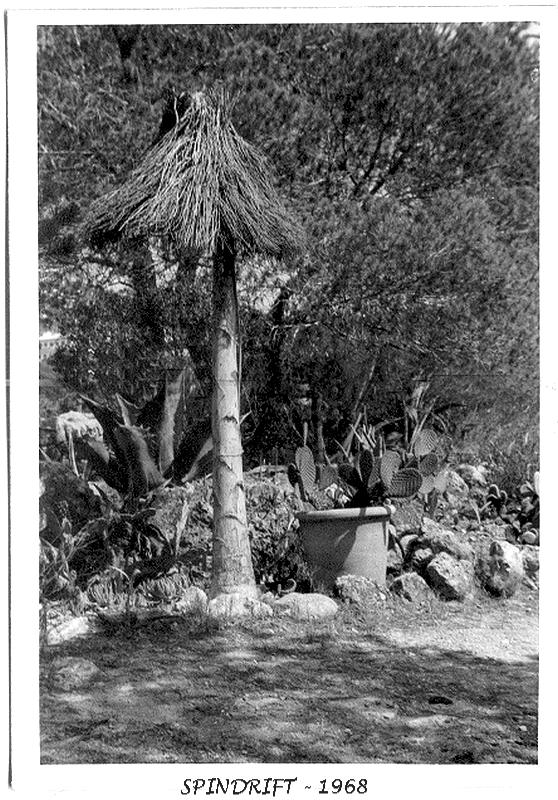
dina moorebowden B
I have been wanting to write a short bio about Dina Moore Bowden, the lovely lady who was the mistress of Spindrift. But I found a complete account of her life in the Journal of San Diego History, written in memoriam on her passing in May of 1981 by Sylvia Arden, archivist of the San Diego Historical Society. It is also with interest that I discovered that a geographical point in Calvià, near Portals Nous, has been named after her:
'Sa Punta de Na Dina'.

So I will insert...with thanks to the SDHS... Sylvia Arden's biography here with the accompanying photos and the above link to the original page.

sfhs logo
Born in northern California, Dina was taken as a three-month-old infant to the Hawaiian Islands, where she lived with her family on a sugar plantation until she was twelve. Returning to California, she became a student of violin, and after graduating high school continued her musical studies in violin and voice in Vienna.

After her marriage to Englishman George Bowden, a voice coach and writer, they lived in New York where their son George, Jr. was born. The Bowdens spent every summer with Dina's family in California.

In the course of travels in 1932, following years of intense work in the life of musical New York, the Bowden trio arrived in Mallorca. They were enthralled when they first learned that Father Junípero Serra was born in Petra, Mallorca. Dina wrote to her family in California, "The realization that we Californians were now on an Island from which this civilization emerged was a tantalizing subject for thought. It aroused a keen awareness of the significance of everything we saw in Mallorca in relation to California."

The Bowdens quickly succumbed to the charm of Mallorca, and decided to settle there. They had a house built at Portals Nous in the Mallorcan architectural style they admired. Dina soon devoted her life to renewing and strengthening the age-old links with her home state of California. She helped organize, and became president of the Amigos de Mallorca, and was largely responsible for the building of the beautiful Museum and Center of Studies in Petra, near the little house where Father Serra was born. Official ambassador for California, Dina greeted and escorted visitors from California to Petra, and hosted many celebrations at the Bowden home at Portals Nous.

In 1948-49 Dina brought an Exhibition of Mallorca Artes and Crafts to libraries and museums throughout California to acquaint people with the culture and history of the Island. Included was an exhibit at the Serra Museum. This was the beginning of a long, close friendship with the San Diego Historical Society. Dina paid the Society a second visit in 1962.

In 1978 and again in 1980, I was privileged to represent the San Diego Historical Society on official visits to Mallorca with David McKenzie Smith, chairman of the Library and Archives Committee and Board member. The Society's plans to reinterpret the Serra Museum with more emphasis on Father Serra and his birthplace excited Dina, and she crammed our suitcases with antique costumes, fabric and exhibit pieces. Dina decided that the Society should also receive her library of rare books on Father Serra, and the albums carefully detailing her active life in Mallorca. She devoted most of her time the past three years organizing the collections to send to us. Shortly before her death, she wrote telling us that the collections were on their way, and how thrilled she was to learn that a room in the Serra Museum, exhibiting her donations, will be named after her.

dina moore bowden 2BDina Moore Bowden involved in her favorite activity—working on an exhibit to commemorate Father Serra.

The San Diego Historical Society has lost a great friend. But all Californians will be forever enriched by Dina Bowden's contributions to us for they have strengthened our cultural links with Mallorca—the native land of our state's founding "Father"—Junípero Serra.


logoSylvia Arden Head
Librarian Librarian/Archivist
San Diego Historical Society

Continue on to Chapter 31 Living in Palma
Go back to Chapter 29 The House at Spindrift

Wednesday, June 24, 2009

The House at Spindrift

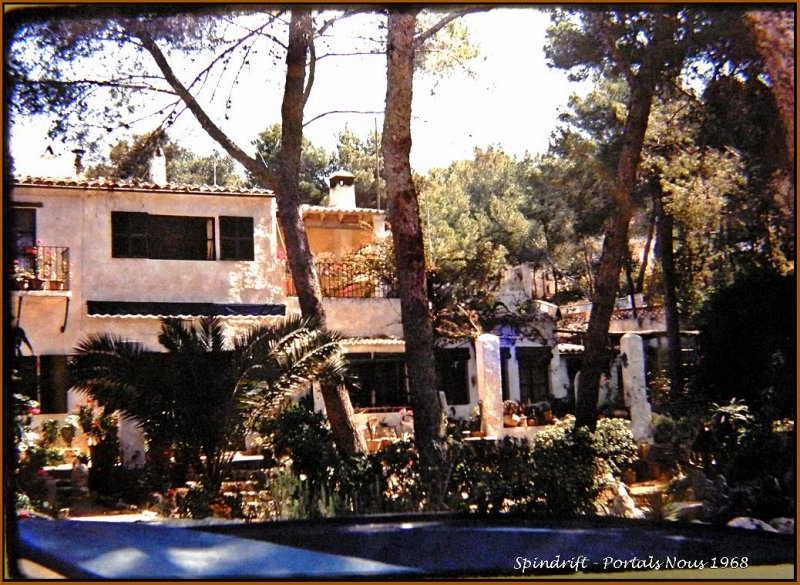
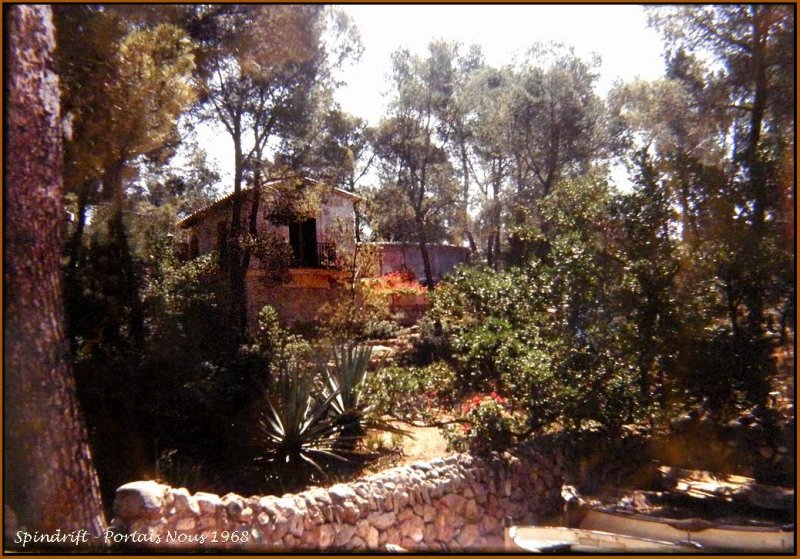
the house at spindrft The main house - (Click to enlarge photos)

Chapter 29

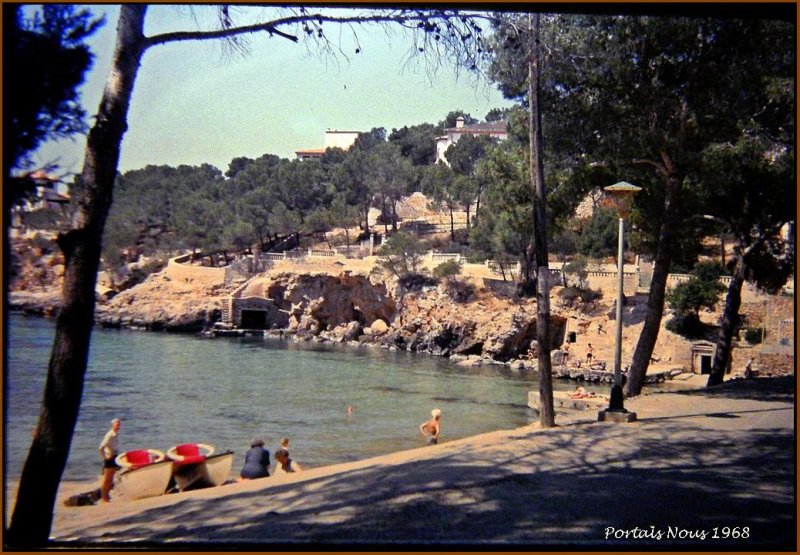
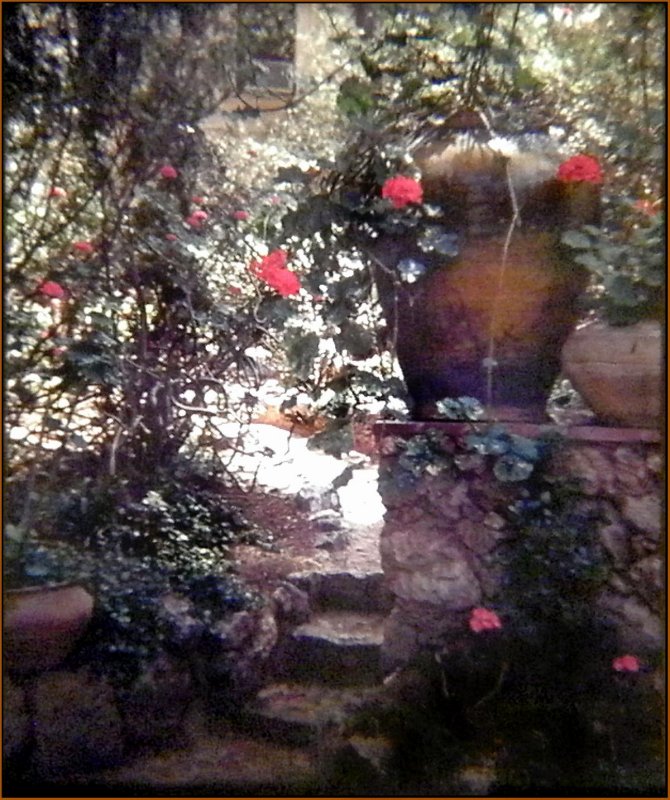
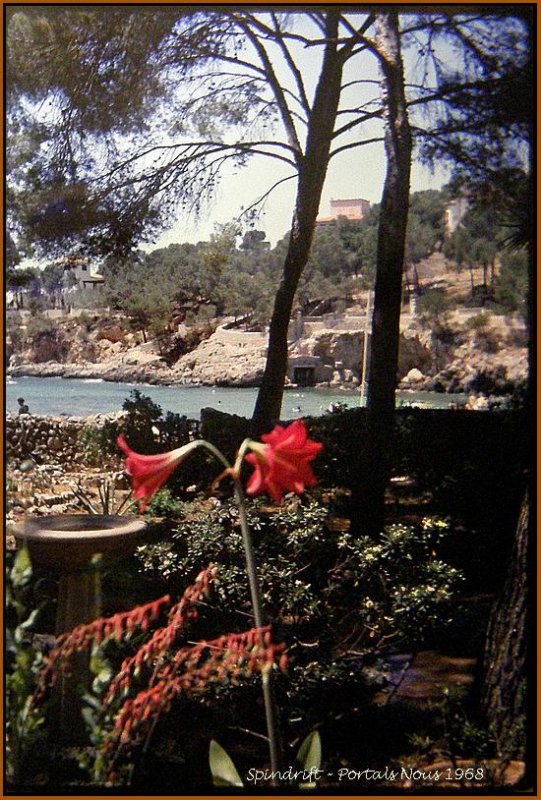
I was so pleased last night when I discovered some coloured slides I had taken in 1968 of the Spindrift estate to complement my black and white photos. For me it was like finding a small treasure in these few transparencies. Unfortunately I don't yet have a slide scanner for uploading them to my computer but for the time being these images will suffice, even though they were reproduced in a low tech manner by using a strong light and a close camera on macro. The above photo shows the main house located at the back of the property at Portals Nous.

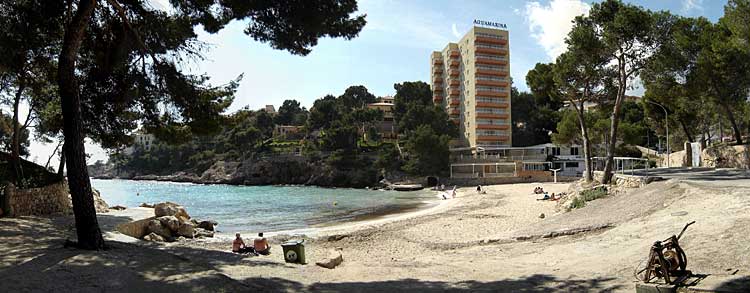
portals beach 1968 The Beach at Portals Nous 1968

My story of Dina Moore and the Bowdens will continue after showing these photos of their beautiful old Mediterranean house and garden.

Ajoining the outer street wall by the entrance was the small house of the Mallorquin couple Catalina and Juan who were the estate caretakers. Catalina cooked and looked after the house while Juan tended the garden and did repairs.

I remember the kitchen of the main house being fitted with old-style double stone sinks with tiny drainholes, used in the manner which I still use today for dishwashing...left side filled with hot, soapy water for washing, right side filled with cold water for rinsing. It was an interesting house although I didn't see all the inside rooms.

flowerpotThe large dining room table was frequently covered with books, newspapers and cuttings which Dina Moore was preparing to save or send to friends who could be interested in news items she had found. I often received envelopes of clippings from her with handwritten notes on her stationery adorned with the image of the Spindrift seahorse informing me of some upcoming musical event in Palma, or a writeup about The Guitar Centre or the Juventudes Musicales, an organization dedicated to furthering young peoples' interest in music.

Here is again the photo print of me in that yellow dress I made before leaving Vancouver. I realized later that this was taken in the garden at Spindrift, not in Palma as I had previously thought. Part of the house is visible behind.

sharon at spindriftHere is a view across the small cove as seen while standing in the garden.

garden at spindrift In the centre of the garden, up a narrow winding path was a small one room stone cottage built in the Mediterranean style, with tiled roof and windows looking over the garden and sea.

cottage at spindrift The Cottage Studio

It was fitted out as a small library with books, a table and comfortable sofa. Dina Moore Bowden kindly invited me to come and spend time in this quiet studio to practice my guitar and read her books. It was a lovely retreat, where I sat alone reading for the first time George Sand's book "A Winter in Mallorca". I read it there, albeit slowly, in the original French as "Un Hiver à Majorque". The name George Sand was the pseudonym of the French novelist Amandine Aurore Lucile Dupin who spent a miserable and cold winter of 1838 - 1839 with Frédéric Chopin in the Carthusian monastery in Valldemossa.

That was the first time I had heard that it could be very chilly in Mallorca in winter time. I had brought no coat with me from Canada, thinking Spain was the land of sunshine, every day of the year!

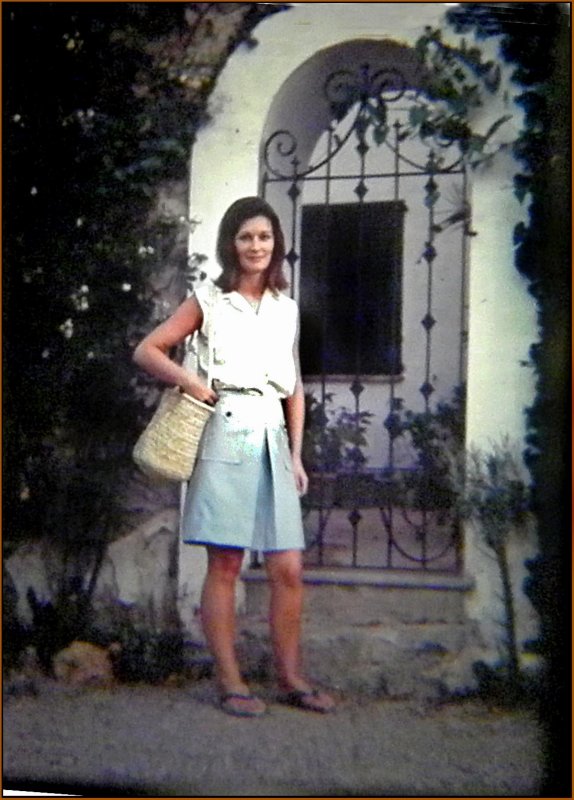
Here I am by the gate, wearing again my straw basket, my one blouse and skirt.

sharon at gate Why is it that as we get older we start to carry more baggage when we travel? At least I do. As a young woman I was content to move to a strange land with one small suitcase, one blouse, two homemade dresses, almost no money and a head full of dreams. Perhaps it's having the dreams and expectations of a wonderful life ahead that makes carrying an extra pair of shoes or warm sweater seem unnecessary.

Continue on to Chapter 30 Dina Moore Bowden
Go back to Chapter 28 Spindrift

Sunday, June 14, 2009

Spindrift

Chapter 28

seahorse(Click to enlarge photos)

Imagine the story of a musical California socialite who falls in love with her voice professor, who marries him, gives birth to a son and eventually settles with her family in 1932 on a beautiful Mediterranean island, where they build a house on a rocky promontory overlooking a small bay, naming it Spindrift.

 view towards fincaFoto credit to Trip Advisor Dizzyo6
The Spindrift promontory in background

This is the true story of a very special lady, Dina Moore Bowden, who became a legend both in her native California and on the island of Mallorca.
But for the moment, I will only outline the setting for this family tale, with which I was privileged to have a fleeting encounter during my years in Mallorca.

Dina Moore Bowden was the mother of George Moore Bowden, the Mr. G. mentioned in my memoir. I will tell more of her history later, but for now I want to describe my brief but memorable visits to Spindrift.

The finca or estate was built beside what was then a sleepy little beach cove called Portals Nous, at only a few kilometers from Palma, the capital city.

beach portals Foto credit to Mallorca Fact
Small cove beach at Portals Nous

Dina had chosen the image of a seahorse to represent Spindrift, to be repeated in ironwork, in decor and on the letterhead of her stationery.

Antoni Mir's photoPhoto above from Antoni Mir's book 'Els Tres Bowden'

The land was surrounded by rock walls and at one end was the high cliff which overlooked the sea. There was a manhole built into the ground which, when raised, uncovered a secret iron ladder leading down to a small cave-like hole in the cliff wall from where one could swim. Another small ladder went into the water so one could climb down into the sea.

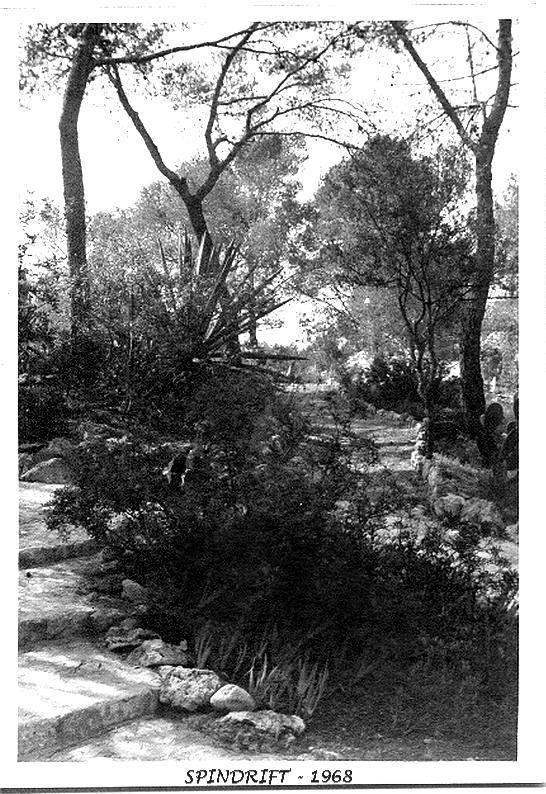
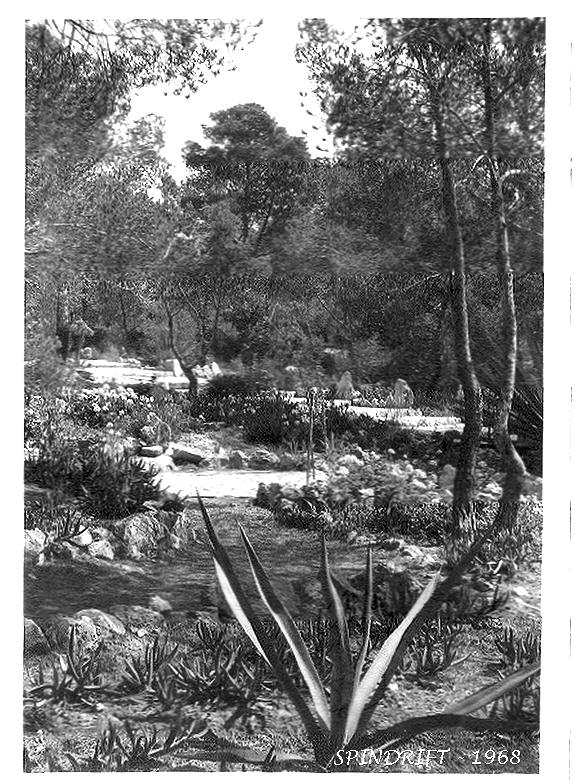
Following are my original black & white photos taken in 1968.

the point
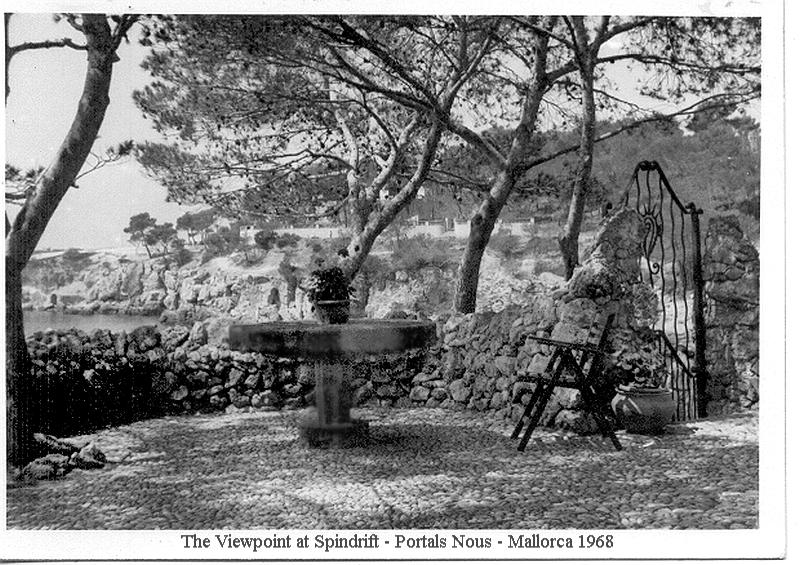
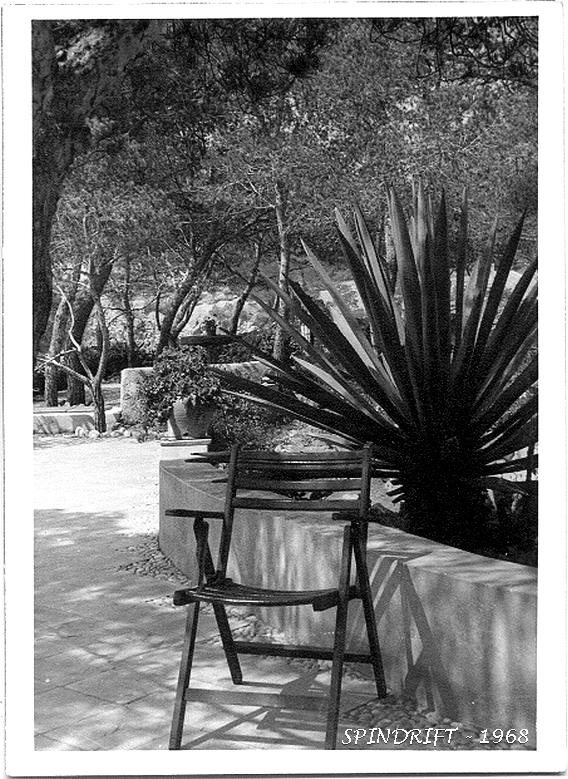
At the top of the promontory was a stone covered patio with an old millstone mounted as a table, with folding green-painted wooden chairs as well as concrete benches around the edges.

the point
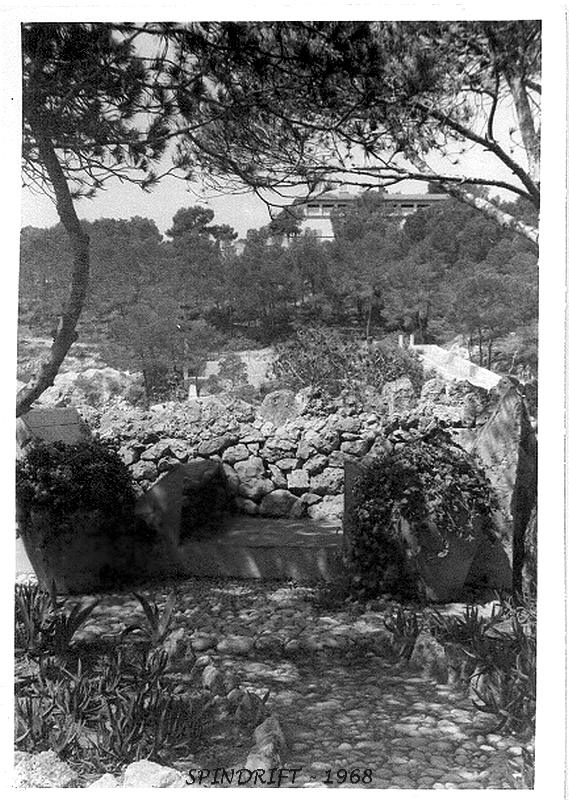
Small pine trees gave shade overhead while dry desert yuccas and succulents edged the pathways. The scent of warm pine needles was everywhere.

chair
stone bench
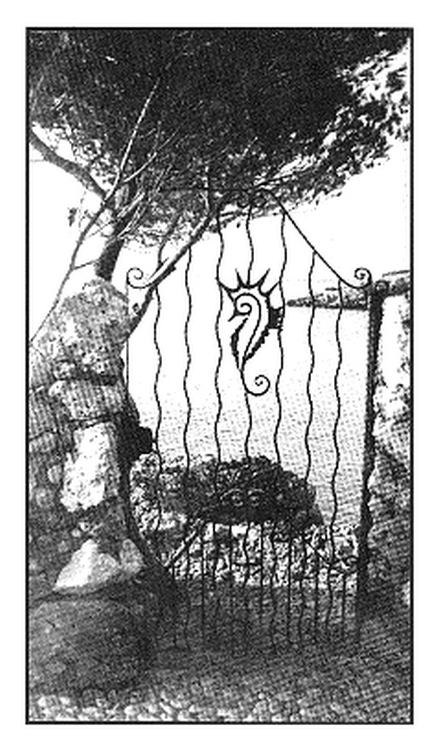
On one side of the patio was a wrought iron gate leading to the rough ground outside the edge of the estate. The seahorse image was at the centre.

zoom of gate My photo of gate from 1968

Once Mr. G., his daughter Helen and I were having a small picnic, consisting of sandwiches we had brought from the apartment while seated around the round table.
thatched pole
When Dina walked up to see how we were doing, she looked with some disapproval at our meager meal, saying that it wasn't really sufficient and that we should have something better than that.

stairs in garden
garden
I imagine that since I had recently arrived from Canada, where a picnic consisted of sandwiches, that I couldn't think of anything else to bring. However some time later, a basket arrived filled with hot and cold goodies prepared by Dina's Mallorquin cook, Catalina. I learned then that the midday meal, no matter where it was taken, should be a substantial one!

Antoni Mir's book
I was recently given a copy of a book written in Mallorquin by Antoni Mir I Marquès entitled 'Els Tres Bowden' (The Three Bowdens) in which he tells the story of Mr. George Charles Bowden (the father), his wife Dina Moore and their son George Moore Bowden. Although I have not a full domination of the Mallorquin language, (similar to Catalàn), I have managed to read and understand nearly all and have found background material which fills out my knowledge of the family. It is a most interesting book and I hope one day that Antoni will also publish it in English and Castellano.

Here is Antoni Mir's website. "La Guitarra Balear", written in Spanish.

I will be continuing in following entries with this story of my contacts with the Bowden family in Mallorca.

Continue on to Chapter 29 The House at Spindrift

Go back to Chapter 27 Spanish Omelette

Tuesday, June 9, 2009

Spanish Omelette

Chapter 27

Spanish Omelette(Click to enlarge)

La Tortilla Española

Although this is not a recipe blog I do like to occasionally show how to prepare the dishes which I learned to love after arriving in Spain. I was introduced to several by the Bowden family's Mallorquin cook, Catalina, and by Helen who showed me how she cooked Spanish style in her tiny kitchen.
Many times when we went on outings in the Citröen, whirring and jouncing across back country roads, we had a tortilla packed somewhere in a picnic basket, along with some nisperos (loquats), sobrasada, Inca biscuits and a bottle of wine.

The Spanish potato, egg and onion omelette is such a popular addition to a summer meal, or as a picnic item, since it holds up well being transported in warm weather. It's also common as a tapa, being served with a slice or two of crusty baguette bread and a small glass of vino.

Here's how I make it:

Spanish Omelette

Ingredients for 4 servings:
3 medium potatoes
3 large eggs
1 onion
salt 1/2 teasp & pepper to taste
olive oil
Italian parsley, chopped (optional)

I use a 7-inch non-stick pan as it's easy to fill, making a nice high and rounded tortilla which is easy to flip over.

1. Slice potatoes lengthwise once, then slice both pieces thinly into half moons. Chop onions into 1/4 rings.

2. Coat the bottom of the pan with oil and when hot add potatoes. Keep turning so they do not burn or go brown.
When golden, remove from pan and set aside in large bowl.

NOTE: Some folks prefer to gently boil or steam the potatoes for 5 - 10 minutes rather than fry them. I've seen it done both ways and I also like to do this.

3. Put chopped onion in pan, if necessary add a little more oil and sauté until soft, without being dark brown. Remove from pan and add to potatoes in bowl.

4. Beat the eggs in a small bowl, add salt & pepper and chopped parsley, and pour over potato & onion mixture in bowl. Turn gently to coat all.

5. Add 2 TBS oil to pan and when hot, pour in the egg, potato and onion mixture. Run the edge of a sharp knife or spatula around the rim of the pan while the egg is
setting to loosen the edges. I also poke it several times in the middle to let some of the runny egg seep down to the pan. Don't let it get too dark or burn.

6. When the edges are set and the middle is still half runny hold a plate over the top and flip pan and all over on to the plate and gently slide it back into the pan.
Don't overcook as the centre should still be juicy.

7. Let cook a minute or two more on that side, then slide it out onto a plate.

8. Cut into wedges as a luncheon dish, or into small squares with toothpicks to be served on a buffet or as a tapa. Or keep it whole to take on a picnic.

The edges should be fat and firmly rounded. If you've never tried making one before, start with a small non-stick pan and when you're an expert move up to a larger pan. A small 7 inch pan will make a nice luncheon omelette for two.

whole omelette
Once you've made a tortilla and have mastered the knack of flipping it over, I'm sure you will find it a welcome addition to your picnics, luncheons or tapas menus.
I hope you like it!

tortilla for oneTortilla for One

Continue on to Chapter 28 Spindrift
Go back to Chapter 26 Driving the Island
Related Posts with Thumbnails